
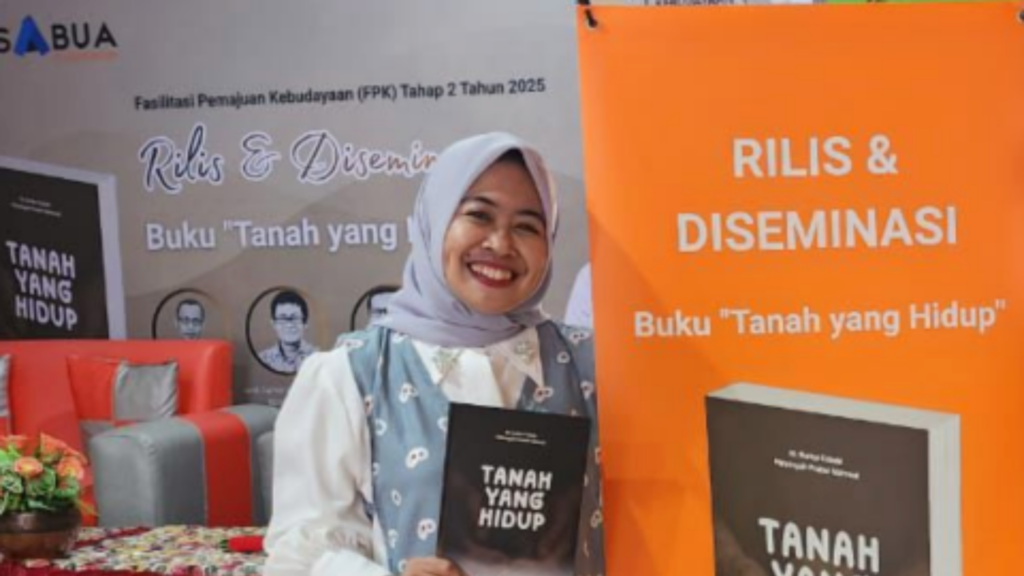
Tanah Yang Hidup (Living Earth) emerges from a commitment that is at once urgent and intimate. The book sets out to document and honor the pottery tradition of Mare, a small island in the Tidore Kepulauan regency of North Maluku, before the knowledge that sustains it quietly disappears. Mare’s pottery tradition has been kept alive for centuries by the island’s women, and it constitutes one of the only surviving traditional earthenware practices in all of North Maluku. Yet it exists largely undocumented. The practitioners are aging, younger generations are migrating to cities, and the plastic and aluminum goods flooding local markets are eroding both the market and the perceived need for traditional ceramics. The book is, as the authors describe it in the preface, an act of appreciation, an attempt to place the Mare pottery tradition in a broader geographical, historical, and social context before that living knowledge is no longer passed from hand to hand.
The work was made possible by the support of the Balai Pelestarian Kebudayaan Wilayah XXI of North Maluku Province, through a Cultural Advancement Facility program. This institutional backing speaks to a growing, though still insufficiently resourced, recognition that intangible cultural heritage in eastern Indonesia deserves systematic attention.
M. Guntur Cobobi was born in Ternate. He holds a bachelor’s degree in Social Anthropology from Universitas Khairun and a master’s degree in Anthropology from Universitas Indonesia, and is currently completing a doctoral degree at the School of Environmental Science, Universitas Indonesia. He serves as a lecturer in Social Anthropology at Universitas Khairun. He is also affiliated with Yayasan the Tebings, the Central Board of ICMI Youth, and HIPKA, the business association of KAHMI.
Fitriningsih Pratiwi Mahmud was born in Kaimana on November 15, 1992. She completed her undergraduate studies in English Literature at Universitas Indonesia and her master’s in Linguistics at Universitas Negeri Jakarta. Her research interests include local cultural identity, North Maluku folk-pop music, and the historical traces embedded in place names across Ternate’s villages, work that treats language as an archive of social memory and spatial experience. She has been a lecturer in English Literature at Universitas Khairun since 2022, and serves as Chair of Sabua Cendekia Timur within the Sabua Foundation. She is also active at Yayasan the Tebings.
Together, the authors bring complementary disciplinary lenses. Cobobi’s environmental anthropology and deep field knowledge of North Maluku’s island ecologies combine with Mahmud’s literary and linguistic training, which gives the book much of its careful attention to local terminology and the way language encodes cultural identity.
Structured across five chapters and running to 96 main pages, the book moves from the geographical and social landscape of Pulau Mare outward into the history, typology, material science, and contemporary challenges of its pottery tradition.
The opening chapter establishes Mare’s geographical position within the historic Moloku Kie Raha, the four-sultanate configuration of Ternate, Tidore, Bacan, and Jailolo. The island covers roughly 12.6 km² and lies about ten minutes by speedboat from the Tidore mainland, divided into two villages, Maregam and Marekofo. The authors then trace the deep historical roots of the pottery tradition, drawing on archaeological research suggesting that Mare pottery has been present since around the fourteenth century, and close with a detailed account of the production process itself, from clay selection and sourcing through mixing with sand, forming by hand, drying, burnishing, and open-air wood-fired burning. All of these steps are carried out predominantly by women.
The second chapter profiles the five canonical forms of Mare pottery. Forno is a sago-cooking griddle, the form most closely tied to the staple food of the North Maluku archipelago. Ngura-ngura is a concave lid designed to retain and recirculate heat during cooking. Boso is a general cooking vessel with multiple sub-types for different culinary purposes, from frying fish to boiling medicinal herbs. Hito is a small ritual censer for burning incense in ceremonial and spiritual contexts. Cobe is a mortar for grinding chili and spices. Each type is discussed in terms of its function, its local and regional names, its role in domestic and ceremonial life, and the specific technical demands it places on its maker. The chapter is rich in ethnographic detail, including the observation that forno are sized according to the number of sago sections they can accommodate, and that the appropriate size varies by destination market. Larger eight-section forno go to the high-sago-production areas of Kayoa and Bacan, while five-section ones serve eastern Halmahera. Potters who distribute their goods across islands must plan their cargo with this in mind.
The third chapter is philosophically the most distinctive section of the book. It treats the four materials involved in pottery-making, earth, sand, water, and fire, not merely as technical inputs but as relational entities whose proper handling embodies a form of ecological ethics. Each element is examined through its technical role, its social significance in the production process, and its symbolic meaning within the community’s worldview. The section on earth is particularly careful, detailing how clay is drawn from two specific sites, Hale ma lu and Halelule, in quantities calibrated to allow natural replenishment. This is an empirical form of resource conservation that the authors connect to a deeper philosophy of reciprocity between humans and the island’s body. Sand for tempering is sourced from silica-rich black beach deposits on Halmahera’s Oba coast, because Mare’s own white coral sand lacks the structural strength required. Even the water used in mixing is described as something to be read and respected, applied sparingly and always with attention to what the clay is telling the potter’s hands.
The fourth chapter addresses the tradition’s resilience, its ecological logic, its role in household economies, and the growing threats to its survival. The authors are honest about what they observe. The knowledge system is fragile because it is oral, female-centered, and transmitted within family lines rather than through broader community institutions. Younger generations are leaving for cities and for the nickel mining sector on Halmahera. Demand for traditional pottery is declining in the face of cheap industrial substitutes. Policy frameworks exist, notably Indonesia’s Law No. 5 of 2017 on Cultural Advancement, but implementation tends to remain focused on ceremonial objects rather than the living knowledge systems that produce them. The authors invoke UNESCO’s Intangible Cultural Heritage framework to argue that what must be protected is not the finished pot but the system of knowing that makes the pot possible.
The final chapter is a brief but resonant conclusion, affirming that the pottery of Mare is not simply an artifact but an integrated way of knowing and living.
The book’s most important cultural contribution is its insistence on the female-centered knowledge system at the heart of Mare pottery. The tradition holds, in local oral history, that pottery was first made by a woman named Mo’re, a figure whose very name, from Mo meaning “she, a woman” and Re meaning “here,” encodes the identification of womanhood with the island itself. This is not merely an origin myth. It has structured the division of labor for generations. Women make the pottery; men support the process by sourcing clay, gathering wood, and handling inter-island distribution. This arrangement is understood not as social subordination but as custodianship. Women are the owners, guardians, and innovators of the tradition.
The book shows how this gendered structure has also functioned, perhaps unintentionally, as an ecological regulator. A well-known local story describes a man named Bede who attempted to make pottery in the 1950s and allegedly began to undergo bodily feminization. The authors read this prohibition not as superstition but as a culturally encoded limit on production scale, a taboo that prevented mass extraction of clay from the island’s hillsides. It is a subtle and original argument, one that invites anthropologists and ecologists alike to reconsider how cultural rules can serve as embedded resource management mechanisms.
The documentation of local terminology is another significant cultural contribution. The same ceramic form carries different names across different trading partners. What Mare people call forno is called keta in Tidore, gunange in Galela, gohoanga in Tobelo, soya in Makian, minoi in Maba and Buli, and rangian among the Bajo. This linguistic pluralism is not mere variation. It traces the actual routes of inter-island trade and cultural contact that have knitted together the archipelagic world of North Maluku for centuries. In this sense, the vocabulary of pottery is also an atlas of a maritime civilization.
The ecological contribution of the book is substantial, though it operates partly through implication rather than explicit argumentation. The production of Mare pottery is structured at every stage by intimate, accumulated knowledge of the island’s material limits. Clay is harvested only from specific hillside sites, and only to a depth that allows natural regeneration. Sand is sourced from elsewhere because the island’s own geology cannot supply what is needed. Firing wood must be dry but not too dense, and the wind direction on the day of firing matters to experienced potters. None of this is written down. All of it is embodied and transmitted through practice.
This is a portrait of what the book calls an ecological ethics of practice, a form of environmental knowledge that does not announce itself as conservation but that functions as such across many generations. In an era when island ecologies across Indonesia face intensifying extractive pressure, the book’s documentation of this embedded form of stewardship is genuinely valuable.
At the social level, the book illuminates how a small-island community has maintained internal coherence and external relevance through a single, multiply embedded practice. Pottery in Mare is at once an economic activity, a domestic technology, a ritual necessity, a vehicle for inter-island relationship, and a medium of social memory. The ritual dimension is carefully documented. Hito, the small censer, is indispensable in the salai jin ceremony, a healing and spirit-mediation ritual of the Tidore people, as well as in tahlilan, circumcision ceremonies, and house-opening rites. This embeddedness in ritual life means that pottery’s survival is partly tied to the survival of those ritual forms, and vice versa.
The inter-island trading relationships that pottery has sustained and reflected are also traced with care. By the late eighteenth century, Mare pottery was already a significant barter commodity exchanged with Tidore and Halmahera. Today, distribution networks reach Ternate, Maba, Galela, Tobelo, Kayoa, Bacan, and even Papua. These are not merely economic connections. They are relationships of recognition, in which communities across North Maluku still actively seek out Mare pottery rather than industrial substitutes. This speaks to a form of cultural authority that the island has maintained for centuries despite its small size and limited resources.
The book also treats the open-air communal firing sessions, where women from multiple households burn their pottery together and each is still able to identify her own pieces among the batch, as a particularly vivid instance of social cohesion. Around the fire, techniques are shared, stories told, and younger women absorb what is never formally taught.
The authors are transparent about what the book does not fully resolve. They note that no systematic visual-ethnographic archive of the production process exists, making the tradition vulnerable to irreversible loss when senior practitioners are no longer able to work. They also acknowledge that community members have limited awareness of the intellectual property protections available under Indonesian and international law, leaving the Mare pottery tradition vulnerable to appropriation without attribution or benefit to its makers.
Tanah Yang Hidup is a work of both scholarly documentation and cultural advocacy. It makes visible a tradition that has persisted for centuries at the margins of North Maluku’s more celebrated histories, the spice trade, the sultanic courts, the colonial encounter, and argues convincingly that this tradition is itself a form of intelligence, ecological, social, and historical at once. The book does not romanticize Mare pottery or its practitioners. It situates both within the pressures and contingencies of contemporary life. But it insists, with evidence drawn from archaeology, anthropology, linguistics, and lived experience, that what the women of Mare have made and continue to make is not a marginal craft. It is a living archive of how a small island community has learned to know its world and sustain itself within it.
For scholars of insular Southeast Asia, intangible cultural heritage, environmental anthropology, and the gendered dimensions of traditional knowledge, Tanah Yang Hidup is a welcome and timely contribution. For a wider audience, it is a reminder that the most profound forms of ecological and cultural wisdom often reside not in institutions or texts, but in the hands of women working quietly near an open fire.